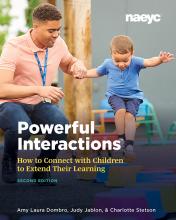
Powerful Interactions: How to Connect with Children to Extend Their Learning, Second Edition

About the Book
-
Step One: Be Present. Pause, tune in to yourself and the moment, and consider how you might need to adjust to create a “just-right” fit with a child.
-
Step Two: Connect. To foster trust and confidence, let that child know that you see her; are interested in what she is doing, saying, and thinking; and want to spend time with her.
-
Step Three: Extend Learning. Make use of your strong connection with the child to stretch her knowledge, skills, thinking, or language and vocabulary.

Table of Contents
-
Welcome
- The Power of Teacher–Child Interactions
- About this Book
-
A First Look at Powerful Interactions
- What Is a “Powerful Interaction”?
- How Do You Turn an Everyday Interaction into a Powerful Interaction?
- What’s in It for You?
-
Step One: Be Present
- What Does It Mean to “Be Present”?
- Doing a Quick “Me Check”
- Getting Better at “Being Present”
- Reflect on Your Practice
-
Step Two: Connect
- What Does It Mean to “Connect”?
-
Seven Strategies for Connecting
- Slow Down, Stay in the Moment
- Keep Learning About Children
- Listen to Children
- Personalize Your Interactions
- Show Respect
- Guide Children’s Behavior
- Keep Trust Growing
-
Step Three: Extend Learning
- What Does It Mean to “Extend Learning”?
- Examples of Extending Learning
-
Ten Strategies for Extending Learning
- Help Children See Themselves as Thinkers
- Respond to Curiosity
- Use Mirror Talk
- Have Conversations
- Inspire Imaginative Play
- Solve Problems Together
- Use Rich Vocabulary
- Laugh with Children
- Ask Questions
- Link the New to the Familiar
-
You Make the Difference!
- Energy—Keep Your Cup Filled
- Confidence—Watch Yourself in Slow Motion
- One Last Word
- Conversation Guide
- References
- Index
- Acknowledgments
- About the Authors
Book Details
ISBN: 978-1-938113-72-7
Publish Date: 2020
Related Resources
Articles
"Promoting Powerful Interactions Between Parents and Children" - In this article, Kristan Stewart-Henry and Amber Friesen discuss how teachers can inspire families to use Powerful Interactions with their young children at home. (Teaching Young Children, August/September 2018)
For Families
"Building Social and Emotional Skills at Home" - Tips families can use to help their children develop social and emotional skills.
"Observation: The Key to Understanding Your Child" - Jarrod Green explores how families can carefully observe their children's behaviors and analyze them to better to determine what it means and how to respond.



Reviews
Intentionality—one of the most overused and misunderstood words in early childhood education—reclaims its meaning in this clear, simple book about how each interaction with a child can build a path to the confidence and curiosity that children need to become collaborative lifelong learners.
—Joshua Sparrow, Executive Director, Brazelton Touchpoints Center, and Associate Professor, Harvard Medical School
Can you take a classic book and improve it? That was my question in reading this new edition of Powerful Interactions, and the answer is yes. Research-based and full of compelling examples, it provides opportunity after opportunity for teachers to reflect on and promote joyful Powerful Interactions that extend children’s learning.
—Ellen Galinsky, Author of Mind in the Making: The Seven Essential Skills Every Child Needs
Relationships are at the heart of everything . . . including Powerful Interactions! With a simple framework, the authors help educators be effective and intentional in their interactions with children. This book sets the stage for creating a positive learning environment and building community while laying the foundation for meaningful relationships throughout life.
—Cate Heroman, Early Childhood Consultant and Author, Cate Heroman LLC
Mastery of the three basic steps of Powerful Interactions makes teaching young children look both magical and elegant! Within the pivotal instruction of “once your offer to connect has been accepted by the child” lies the basis for cultivating an authentic, trusting, respectful relationship between teacher and child and, by extension, the family as well. The special features remain key for teaching teams to measure progress and talk about their evidence-based work.
—Jerlean Daniel, Associate Professor Emeritus, University of Pittsburgh, and Former Executive Director, NAEYC
The continuous study and implementation of Powerful Interactions has had a profound impact on our early childhood laboratory program. We have seen the positive effects in relationship building, respectful interactions, and enriched learning experiences. The children, families, teachers, and college student assistants enthusiastically embrace the beautiful content of this book. It serves as quality professional and personal development for all.
—Beth Huber, Director, East Tennessee University Little Buccaneers Early Childhood Laboratory Program
This book is a great resource for my district. The first edition has been used in professional development for leaders of our P–3 Initiative and as part of the district’s high school early learning program. It is an easy read for educators as well as a fantastic resource for families.
—Minerva Pardo, Family Engagement Coordinator, West Valley School District