Free play and guided play—together known as playful learning—are pedagogical tools through which children can learn in joyful and conceptually rich ways.
Authored by
Authored by:
Brenna Hassinger-Das, Kathy Hirsh-Pasek, Roberta Michnick Golinkoff
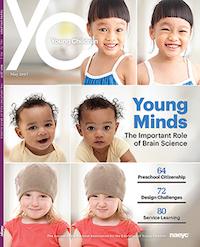
If you’ve visited NAEYC.org lately, you’ve seen our tagline: Promoting high-quality early learning by connecting practice, policy, and research It’s not just a slogan, it’s our guiding principle—and it’s exemplified by the May issue of Young Children.
Of all that brain science has taught us over the last 30 years, one of the clearest findings is that early brain development is directly influenced by babies’ day-to-day interactions with their caregivers.
Free play and guided play—together known as playful learning—are pedagogical tools through which children can learn in joyful and conceptually rich ways.
Authored by
Authored by:
Brenna Hassinger-Das, Kathy Hirsh-Pasek, Roberta Michnick Golinkoff
Something special is happening in Head Start of Lane County, in Springfield, Oregon.
Authored by
Authored by:
Eric Pakulak, Melissa Gomsrud, Mary Margaret Reynolds, Theodore A. Bell, Ryan J. Giuliano, Christina M. Karns, Scott Klein, Zayra N. Longoria, Lauren Vega O'Neil, Jimena Santillán, Helen Neville
Reading the articles in this Young Children cluster about social and emotional development, I can’t help but dream of a world in which all children reap the benefits of the research-based practices highlighted here.
Children with higher emotional intelligence are better able to pay attention, are more engaged in school, have more positive relationships, and are more empathic.
Authored by
Authored by:
Shauna L. Tominey, Elisabeth C. O’Bryon, Susan E. Rivers, Sharon Shapses
Many behaviors have cultural roots that teachers can capitalize on to foster each child’s developing identity, share cultural lessons with the whole class, and help children cultivate shared norms for their behavior as students.
Challenging behavior can signal difficulty with social and emotional adjustment—foundational competencies that are linked to children’s school readiness and later school success.
Motor development is a constant learning process. A child’s body is continuously growing and changing, and his environment offers different opportunities for movement.
Authored by
Authored by:
Sandra Petersen, Emily J. Adams, Linda Groves Gillespie
As a master’s student reflecting on my elementary school education, I realized that the academic knowledge that I gained each year seemed to have been related to the social and emotional feel of the classroom.
Solving the problem of suspensions and expulsions in early childhood education, which are disproportionately experienced by children and families of color, is a collective and systemic responsibility
It is time for families, teachers, child care providers, schools, and communities to embrace health and wellness as an important factor in the early childhood experience.